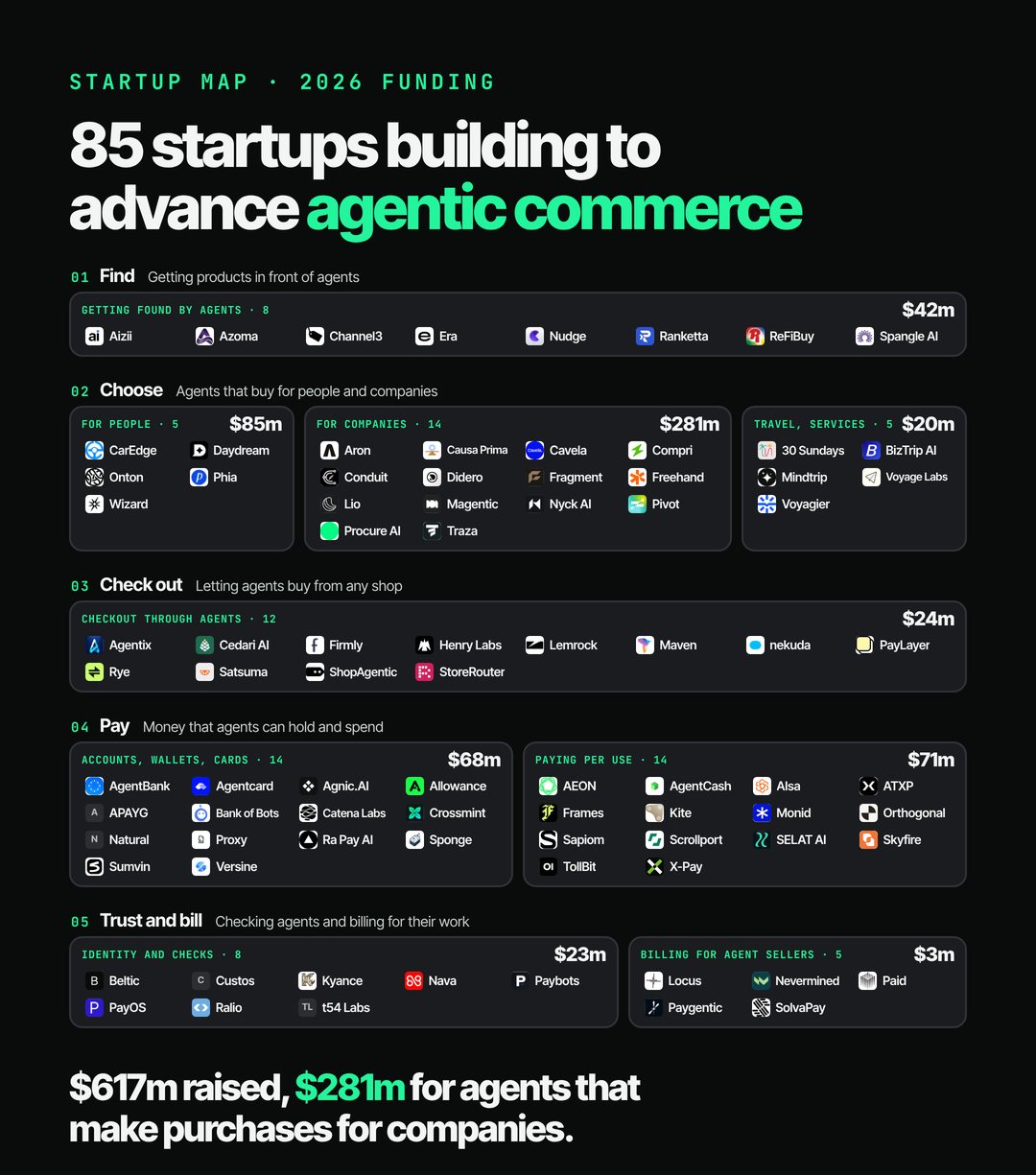
The biggest bets in agentic commerce are agents that buy for companies.
AI agents are starting to find and buy things for people and companies, and the big players are moving fast: OpenAI put a wallet inside ChatGPT on 13 Nov 2026. Around them, startups are building every other step.
We looked at the steps involved in making a purchase and mapped 85 rising startups building for them: getting found, choosing, checking out, paying, and the trust and billing behind it. Each is a private company started in 2020 or later, with a product live or announced, built mainly for agents that find, buy, sell or pay.
Together they announced about $617m of funding in 2026. Agents that buy for companies took $281m of it, more than twice any other group: Freehand ($75m Series B), Fragment ($56m across its seed and Series A), Pivot ($40m Series B), and Didero and Lio ($30m Series A each: Didero, Lio). Shopping agents for people come next with $85m, all of it Wizard ($50m) and Phia ($35m).
Our take: the big players are building fast to own the rails, while dozens of startups take agentic commerce apart into its components. Markets tend to come apart like this before they come back together. Over the next two years, most of these components are likely to be bought or rebuilt as features of the big platforms, as Stripe did with Bridge for stablecoin payments and Metronome for usage billing. The startups that stay independent will own the steps that are hard to copy: trust and permissions for agents, and purchasing agents built deep into a company's procurement.
Which startup did we miss? Tell us on LinkedIn. Every startup's website, and a source for each round, is listed below the map.